Showing posts with label Massachusetts. Show all posts

Saturday, May 24, 2014

Footnotes of History: Henry Wilson


In less than a week, I am graduating from college and leaving the Boston area for the foreseeable future, so I've been making a point of checking off a few remaining things I wanted to do in these parts, including visiting the Cobblery that once belonged to Henry Wilson, 18th Vice President of the United States.

Several years ago a friend of mind had told me about the Shoe Shop (which I want to call a Cobblery, because it's just sounds better), and I have been meaning to visit it ever since. Last week, I finally made my way over.

I braved a slight drizzle to take this picture.


I knew nothing about Henry Wilson, and what I know now has been gleaned entirely from his Wikipedia page. Here are a few choice facts:

1. He was the running-mate of Ulysses S. Grant.
2. He died in office.
3. Before entering the political world, he worked as a cobbler in Natick, Massachusetts.
3. He was a Radical Republican.
4. His birth name was Jeremiah Jones Colbath.

Let me repeat that last one. His birth name was Jeremiah Jones Colbath. Wikipedia does not delve deeper into why he changed his name, nor does it clarify why he chose the infinitely less cool name of Henry Wilson.

In any case, my brief sojourn into the world of Henry Wilson has made me think more about people I like to call "Footnotes of History." Close to the action of major historical events, but not important enough that schoolchildren will grow up hearing your name. There's something that really appeals to me about men like this, who once were prominent and well-known, but have since drifted into obscurity. Maybe it's because, like my youthful fascination with John R. Tanner, former governor of Illinois and lecherous soap opera villain, obscure historical figures don't come with as much baggage, and therefore it's easier to project whatever characteristics you want to on them.

In the case of Henry Wilson, as soon as I saw his birth name was Jeremiah Jones Colbath, I conjured up an image of a young lumberjack in rural New Hampshire who had killed the debauched son of a prominent businessman who had dishonored his sister , and so he changed his name, moved to Natick, and became a cobbler in order to escape his criminal past. I seriously doubt I could have had the same reaction if I heard that Teddy Roosevelt's birth name was Edward Kimberly.

But that's the fun of Footnotes. The holes in their biography are opportunities for some (most likely completely inaccurate) theorizing. For all I know, Henry Wilson just hated the name Jeremiah and wanted a name that was less of a mouthful. But I like the idea that there's a crazy story lurking behind his seemingly ordinary facade.

Saturday, July 28, 2012

Presidential House Visit: George H. W. Bush Birthplace


George H. W. Bush Birthplace
Milton, Massachusetts
One of the great joys of this project has been the amount of care that goes into the upkeep of the houses. Maintaining a historic home is a labor of love that needs both funding and the passion of people who care. The fact that so many sites still exist today, even for the most obscure presidents is a testament to the people who keep them going.

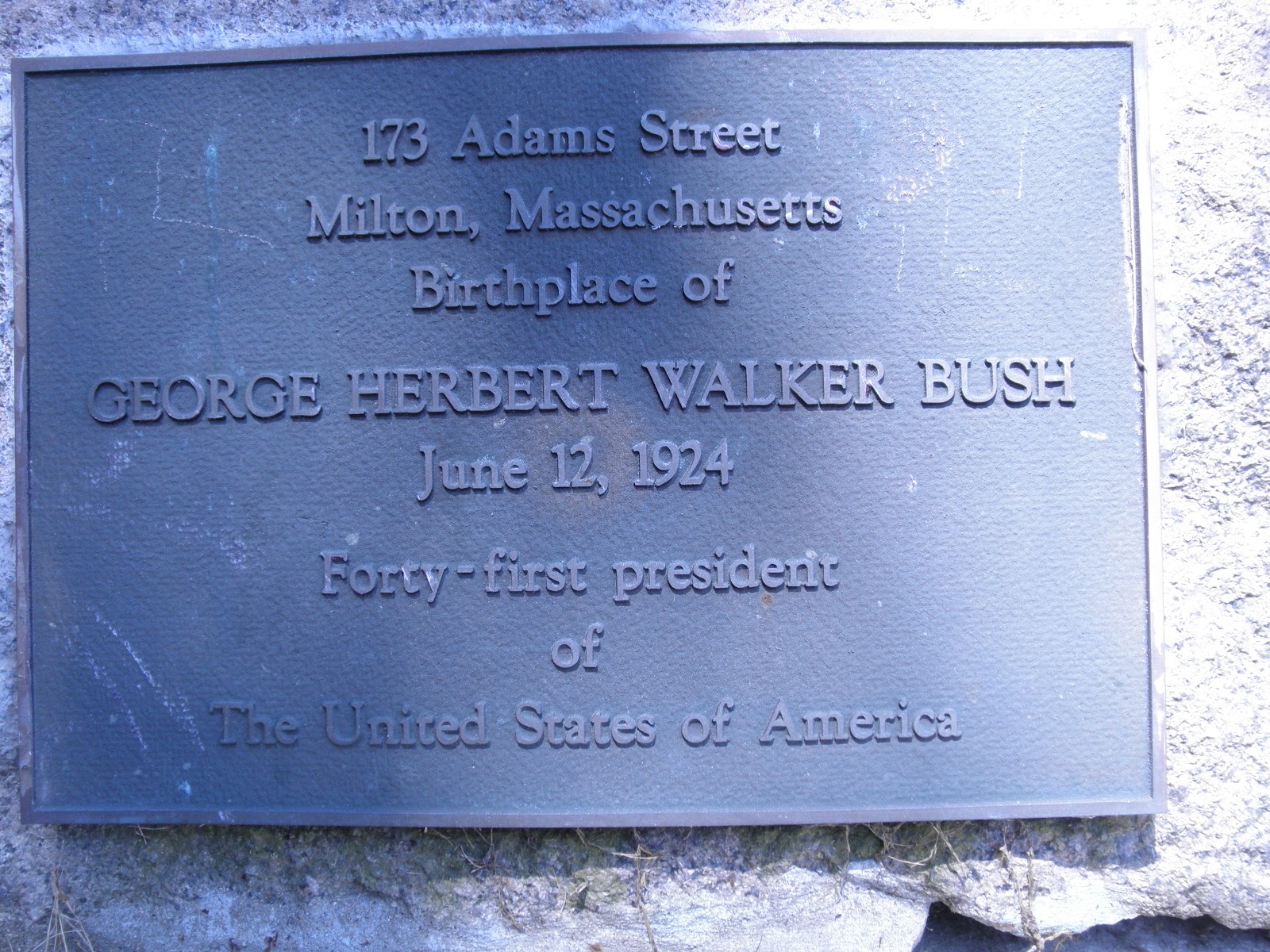
Plaque on a rock in front of the house
The George H. W. Bush Birthplace was, unfortunately, an example of what can happen when that funding and passion doesn't come through. The house still stands just south of Boston in Milton, Massachusetts just several miles from the Adams National Historic Site in Quincy. The house is privately owned, but a marker stands on the property explaining the historic nature of the house, which is blocked by trees and bushes, so I had to go up the driveway to get a better look at it.

I almost wished I hadn't, because it upset me. I couldn't describe it as dilapidated, but it certainly wasn't in good shape. I wasn't expecting this, mostly because the other houses in the area look to be about the same age and are in excellent condition. The house itself was a large wooden Victorian with a welcoming front porch, and if taken care of, would be quite beautiful. I hope that someday soon the house will find a champion and be preserved as befits the birthplace of a president.

Monday, May 28, 2012

Presidential House Visit: John F. Kennedy Birthplace


Although it does not bear her name, the John F. Kennedy National Historic Site in Brookline, Massachusetts is more of a tribute to Rose Kennedy and her young family than it is to our 35th president. The Kennedys lived in the house for only six years, during which time John was born, but they sold it in 1920. The house had changed hands several times when Rose bought it back in 1966 after her son had been assassinated. She restored it herself according to her memories and gave it to the park service fully decorated and renovated to the way it was in 1917.


Or at least the way she wanted it to be. The house is beautiful, surprisingly modest, and happy, but it’s hard to not feel a sense of looming tragedy. By the time Rose repurchased the house, everyone who had lived in it was either dead or unable to help her with the project: Joe Jr. had died in the war in 1944, Rosemary was incapacitated due to a botched lobotomy, Joe Sr. had suffered a debilitating stroke in 1961, and John had been assassinated in 1963. Rose was the only one left, so the house acts as a memorial to her family in a simpler, happier time.


For all the effort that went into presenting the house as a cozy, cheerful home, there are still signs of the dysfunction the Kennedys became infamous for. For example, the master bedroom contained two twin beds, which I initially thought could not have been the true state of things, except the park ranger told me they really did sleep in separate beds. Given the number of children they had, it seems it didn’t make much difference, but it still seemed slightly odd to me. The park ranger told a story about how after Jean, their eighth child, was born, Joe gave Rose her choice of three diamond bracelets as a gift. When a friend asked what he would give her to top himself if they had another child, he replied with “a sock in the eye.” Charming.


Another park ranger story involved Rose leaving on a trip when the future president was about seven years old. As Rose was saying goodbye to her children, Jack turned to her and said, “A fine mother you are to leave us!” His mother, racked with guilt, returned several minutes later to check on her children, who were playing happily despite her absence. Apparently, little Jack knew exactly where to strike to create the most damage.


Edward Kennedy described the atmosphere as one of “spirited competitiveness,” but I would describe it more as “ruthless ambition.” The kind of success the Kennedys had would not have been possible if they were not ambitious and willing to use almost any means necessary to achieve their goals. Perhaps the greatest rivalry in the family was between Joe and John; Joe was always physically stronger than his younger brother, but John used his cunning to outwit his older brother. Perhaps it’s just because I have an usually good older brother, but I found their relationship appalling. My brother would never have purposefully hurt me, physically or emotionally, so the constant fighting between the two oldest Kennedy brothers disturbed me more than it should have, since they were most likely acting like normal little boys.


I think the trouble I have with Kennedy is that I view him less as a president and more as a celebrity. Bits of family gossip are more memorable to me than John Kennedy’s political record, so I find it hard to separate him from his glamorous family. This was partially intentional; the Kennedys had strong ties to Hollywood and Rose raised them to live public lives, just as she had as the daughter of the mayor of Boston. Seeing the Kennedy Birthplace, untainted as it is by the later tragedies and scandals the family faced, made me wonder how their life would I have been different if the “spirited competitiveness” had been toned down a bit. Fame and power are heady things, but they can take away as much as they can give.


I got the sense that Rose understood that when she returned to her modest starter home. The house has an aura of bittersweet nostalgia, helplessly aware of the troubles to come, but hopeful for a better future. “We were very happy here,” the voice of Rose Kennedy says in a recording played at the end of the tour of the house, and you get the sense they were never quite so happy again.